From original document to public row
- Identify the reportRecord the publisher, reporting period, population or care setting, and stable source link.
- Extract the printed resultKeep the original organism and antibiotic labels, percentage, metric, count, and page or table locator.
- Normalize for searchAdd canonical names without replacing the source wording.
- Verify before releaseCompare candidate rows with the original report before they enter a dated public release.
- Calculate from eligible rowsFilters, reported metric, denominator class, source year, and geography determine which rows support a summary.
A traceable measurement
One result, from paper to map
The printed value and the public record stay side by side. Follow the same reported measurement from Stanford's antibiogram into NovAMR.
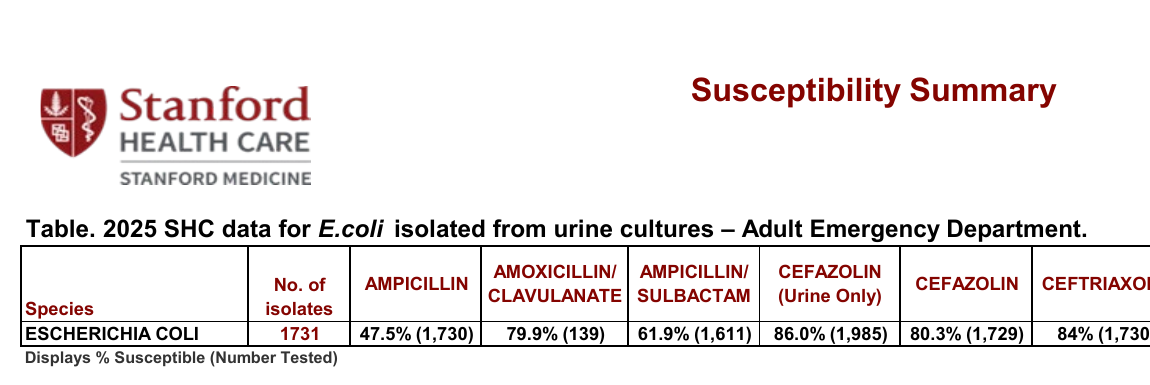 View full excerpt
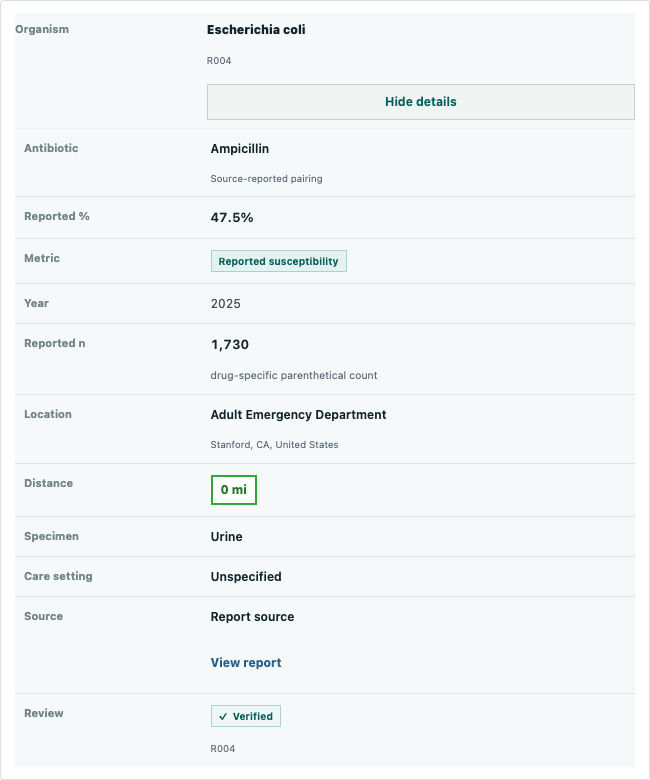 View Explorer capture
- Organism
- Escherichia coli
- Antibiotic
- Ampicillin
- Report scope
- E. coli isolated from urine cultures
- Source locator
- Page 1, E. coli row, Ampicillin column
Record and denominator details
Raw labels ESCHERICHIA COLI and AMPICILLIN are retained. The parenthetical count is stored as a drug-specific reported n. Provenance: R004 · IV1256AAABBEFF88359ECF.
Source excerpt: Stanford Health Care. The original report remains the publisher's work. Regional summaries in NovAMR combine eligible rows and are not the same as this individual source measurement.
Counts remain in separate evidence classes
- Drug-tested n
- A count printed for the organism-antibiotic result. This can support the primary weighted median.
- Organism-level n
- A source-wide or organism-row count. It is reported separately as an approximation and is not blended into drug-tested weighting.
- No compatible n
- A row without a usable denominator. These rows receive an unweighted median, range, row count, and source count.
Reported metrics remain distinct
Susceptibility uses a source-reported susceptible value. Resistance uses only a source-reported resistant value. NovAMR does not calculate resistance as 100 minus susceptibility because intermediate and other categories may exist.
Time and geography are explicit
Latest available per source selects each source's most recent eligible period. Map areas use real administrative boundaries where available; local nearest-source polygons are comparison regions, not clinical catchments or official service areas. Source-reported coordinates and estimated centers remain labeled separately.
Implementation references
The public data dictionary defines every exported field, null rule, count scope, and verification label. The limitations page explains where comparisons can fail.